
Greg Asner: "Western Science and Indigenous Community Unite to Conserve a Hawaiian Reefscape"
Event Details
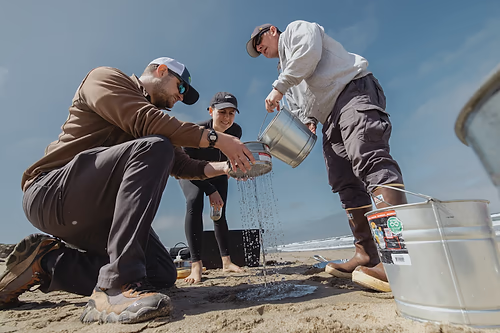
Polynesians made landfall on the southern end of Hawaii Island some 1600 years ago, kicking off centuries of accumulated Hawaiian knowledge at the land-sea interface and along one of the last remaining intact reef ecosystems in the archipelago. Even following western contact two centuries ago, reefs of South Kona District (Hawaii Island) benefitted from their relative isolation. However, the past three decades have seen the rise of more intensive commercial and recreational fishing and widespread reef abuses, negatively impacting traditional fishing practices, biological diversity, and ecosystem conditions. In 2022, Hawaiians from the Village of Milolii signed a game-changing agreement with the State of Hawaii to co-manage 30 km of coastal reef, making it the largest culturally-based marine managed area in the main Hawaiian Islands. Here I describe how traditional knowledge and western science came together to demonstrate a need for a new marine managed area, and how an integration of approaches can drive decision-making towards a more sustainable reef future based on collaboration between government and community. Along the way, we look at some high-tech reef science as well as as low-tech community engagement covering essential ingredients such as reef ecology, fisheries management, education, and law enforcement. The conservation story continues to unfold for Milolii, but the approach is scalable in other regional contexts with a fusion of Indigenous knowledge, western science, and dedicated community support programs.
Greg Asner is the director of ASU's Center for Global Discovery and Conservation Science. He serves on the faculty of the School of Ocean Futures (primary) and the School of Geographical Sciences and Urban Planning (secondary). Asner is an ecologist recognized for his exploratory and applied research on ecosystems and climate change at regional to global scales. His research spans the areas of spatial ecology and biodiversity, coral reefs, terrestrial carbon cycle, animal-habitat interactions, and climate change. He develops scientific approaches and technologies for investigation and conservation assessments of large ecoregions. Asner has published hundreds of scientific articles and has served in numerous national and international programs with NASA, the U.S. State Department, and the United Nations. He is a recipient of multiple scientific and sustainability awards and is an elected member of the U.S. National Academy of Sciences.