
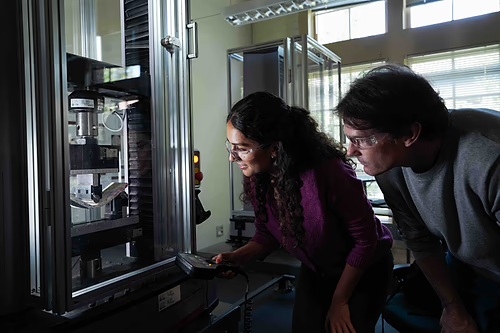
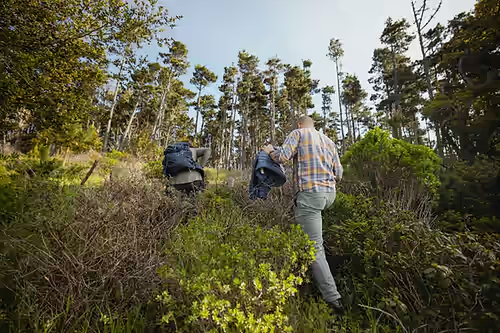
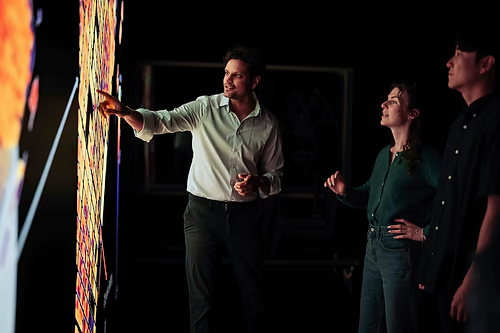
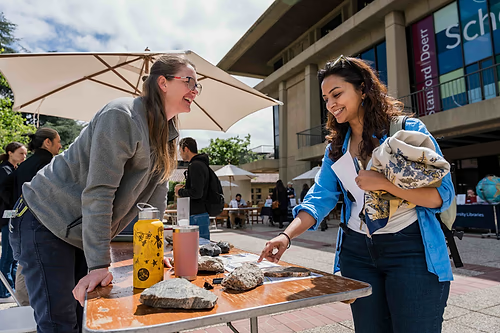
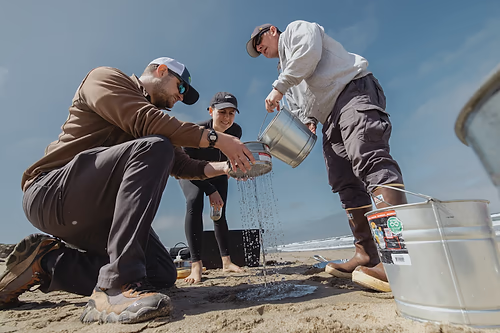
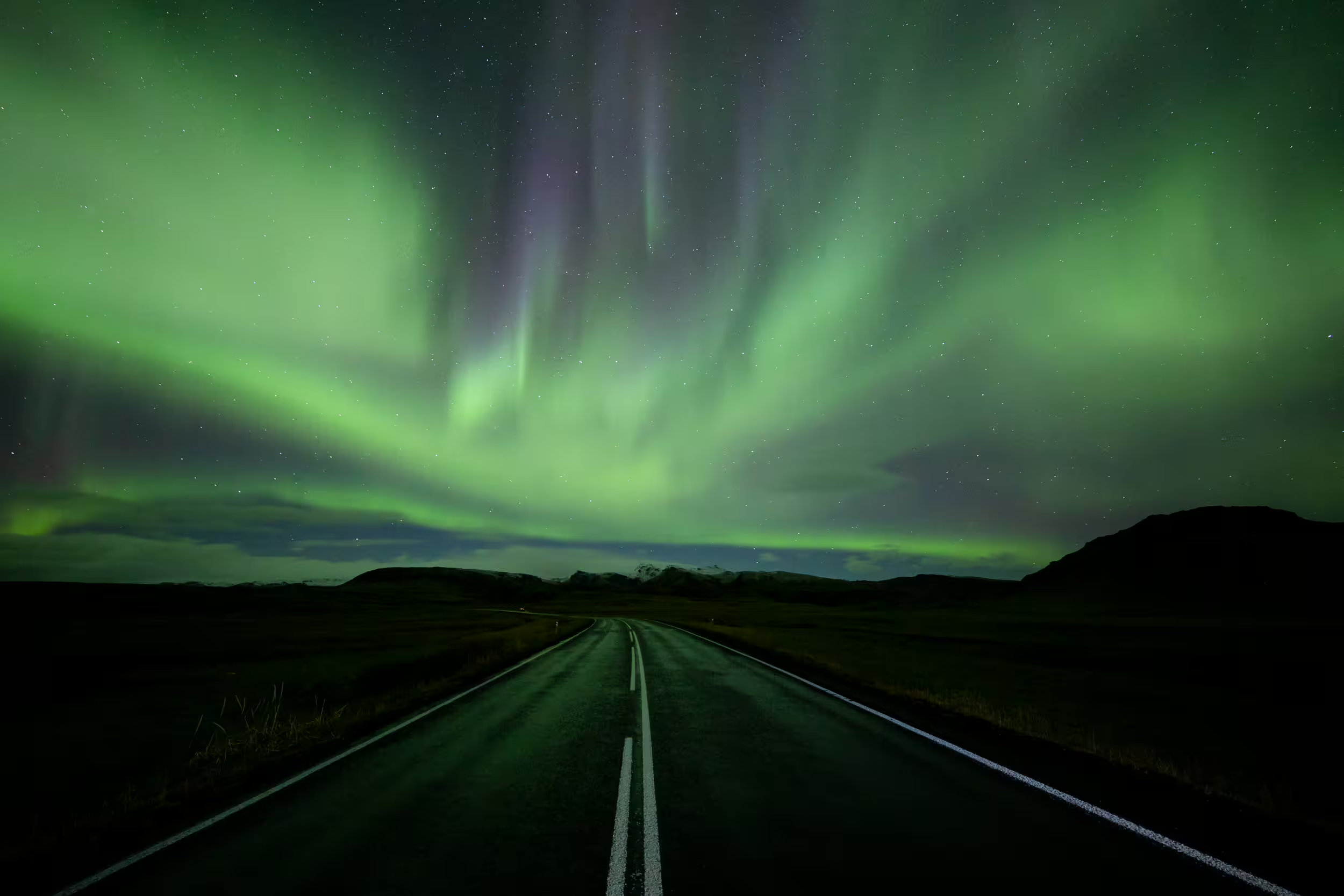
An undergraduate, a graduate student, and a staff member have won the 2018 Stanford Earth Photo Contest. Winners were Human Biology major Hanna Payne for Best Field Photo, PhD candidate Meredith Goebel for Best Lab Photo, and Stanford Earth Materials Lab manager Katie Dunn for Best Landscape Photo. The photo contest, hosted by the Stanford School of Earth, Energy & Environmental Sciences (Stanford Earth), was undertaken in the fall and winners were announced Dec. 6.
“Congratulations to all,” said Stanford Earth Dean Steve Graham. “The number and variety of submissions was truly impressive, illustrating the wide variety of science and engineering research and teaching conducted all over the globe.
“But for all of the evocative scenery in the photos submitted for our contest, its real role is as the backdrop for the important work we do in Stanford Earth, whether in the terrestrial realm, or in the oceans, or sampling the biosphere,” Graham said. “We in Stanford Earth are truly fortunate to study the Earth and to have talented photographers among us who document what we do, how we do it, and where we do it!”
Nearly 200 photos were submitted from around the world and from every corner of the school – as well as from students outside the school who are engaging in programs led by Stanford Earth faculty. Hanna Payne, for example, is a HumBio undergraduate who was participating in Rob Dunbar’s Stanford at Sea program when she snapped the winning Minke Whale shot in the Field Photos category.
Judges included Stanford Earth Senior Associate Dean Scott Fendorf, Stanford Earth Dean Steve Graham, Educational Affairs Program Director Audrey Yau, Earth Systems Science PhD student Shersingh Tumber-Davila, Geological Sciences PhD student Molly Witter, Associate Communications Director and School Highlights Editor Dee Tucker, and Associate Dean for Marketing/Communications Barbara Buell.
Contestants were asked to submit in one or more of three categories: 1) Landscape photos showing the sheer beauty of what we experience in our work with the Earth. These were judged on composition, content (scenic beauty), and image quality (clarity, resolution, lighting). 2) Field photos depicting students directly engaged in field work. These were judged on composition, content (tells a story), and image quality. 3) Lab photos depicting our students, faculty, or researchers at work in the lab. These were judged on composition, content (tells a story), and image quality. The top winner in each category received a set of Apple wireless AirPods.
View the photos here:
Category: LANDSCAPE
Milky Way
The Milky Way over the Green River in Utah on the Crossing the Cordillera field trip.
Photographed by Katie Dunn, Stanford Earth Lab Manager.

LANDSCAPE: Semi-Finalists


Category: FIELD
Minke Whale
A juvenile Minke whale, cruising the waters of the South Pacific, greets student sailors Daela Tipton and Neil Singh aboard the Stanford at SEA program ship.
Photographed by Hanna Payne, human biology undergraduate student.

FIELD Semi-Finalists


Category: LAB
Tubes
PhD candidate Meredith Goebel labels calibration samples from a photometric tracer experiment in the lab.
Photographed by Meredith Goebel, Geophysics PhD student.

LAB Semi-Finalists


LANDSCAPE Finalists
| A leafless Pinus Balfouriana stretches up against a cloudy sky in the high desert just east of the Sierra Nevada. Photographer: Tule Horton | Grand Prismatic Spring, Yellowstone National Park Photographer: Hailun (Cindy) Ni |
Photographer: Tule Horton
| Morning Glory Pool, Yellowstone National Park. Photographer: Hailun (Cindy) Ni | Decrepit farmhouse against a wind farm in Kansas. Photographer: Ryder Kimball |
| A blue iceberg drifts out to sea along the Mars-like tundra of Northern Spitsbergen. Today, the archipelago of Svalbard is located just a few hundred miles from the North Pole, but this was not always the case. Photographer: Syler Peralta-Ramos | Unbelievably clear water as we inch our way through the shallow reefs of Palau. Undergraduates Holly Francis and Natasha Batista sit in the bow of the boat. Photographer: Heidi Hirsh |
Photographer: Syler Peralta-Ramos
| Sand dunes from the Namib Desert of Namibia. The tiny dots are trees. Photographer: Joan Roughgarden | Drone shot of miocene thin-bedded turbidites exposed at low tide along the eastern coast of Mahia Peninsula, North Island, New Zealand. Photographer: Nora Nieminski |
FIELD Finalists
| Hiking guide chips away at ice to clear a path through Vatnajökull ice cap, Iceland. Photographer: Ryder Kimball | Zihan Wei captured his own shadow when standing on a huge piece of granite at Alabama Hills, Eastern Sierra, California during the GS184 field trip led by Professor Gail Mahood. Photographer: Zihan Wei |
Untitled. Photographer: Hannah Joy-Warren | Undergraduate Adam Berkhert reads while resting in the sails atop the ship’s lab. All around him, the waves of the South Pacific test the sea legs of the students and crew aboard the SSV Robert C. Seamans. Photographer: Hanna Payne |
Stanford undergraduate Holly Francis takes a break from field work in Palau to show me how to blow bubble rings. Photographer: Heidi Hirsh | Hannah Shabb, ’20, is pictured sitting surrounded by the mountain ranges in Mount Baker National Forest, Washington. Photographer: Hannah Shabb |
Untitled. Photographer: Hannah Joy-Warren | Nora Nieminski, PhD ’17, points out the severe deformation of Neoproterozoic cap carbonate that records the Marinoan Snowball Earth Glaciation in Damara Orogen, Namibia. Submitted by Nora Nieminski. Photographer: Jared Gooley | Energy resrouces engineering undergraduate Andea Scott enthusiastically collects a soil core sample. Photographer: Maceo Porro |
| Aliyah Chavez ’18 and Sarah Vernallis ’19 watch the waves break on Kaua’i’s north shore during the 2016 Wrigley Field Program in Hawaii. Photographer: Michael Burnett |
LAB Finalists
| Field work is not always glamorous. Dave Mucciarone (Dunbar Lab Manager) troubleshoots the Dissolved Inorganic Carbon (DIC) system after our first night of high resolution experimentation. Photographer: Heidi Hirsh | Students from Adam Brandt’s Environmental Assessment and Optimization group (EAO) prepare a (tenure-) surprise for him in his office. Photographer: Holger Teichgraeber |
| Hans Dejong, a former Dunbar PhD student, is pictured working in Rob Dunbar’s carbon system lab setup at sea on board the RVIB N.B. Palmer in Antarctica in 2018. Photographer: David A. Mucciarone |
| When the environmental geophysics research group have technical issues who do they call? PhD candidate Leighton Watson. Photographer: Leighton Watson |